
Sometimes you have to say goodbye to start anew – or, more precisely, say good bye to Hamburg’s most infamous club, the Golden Pudel, to enter the universe. Viktor Marek, most recently managing director of this notorious nightclub, has given up his job and is now living as a transcontinental music impresario somewhere between Sicily and Burkina Faso, where he works – among others – with the fabulous Les Soeurs Doga.
His musical partner for this piece of work, Ashraf Sharif Khan, comes from Lahore, is a sitar virtuoso, the scion of a centuries-old musical dynasty, and has long been a star of classical music in Pakistan. Together they form a duo that moves between worlds as naturally as if borders were just an annoying graphic convention on old atlases.
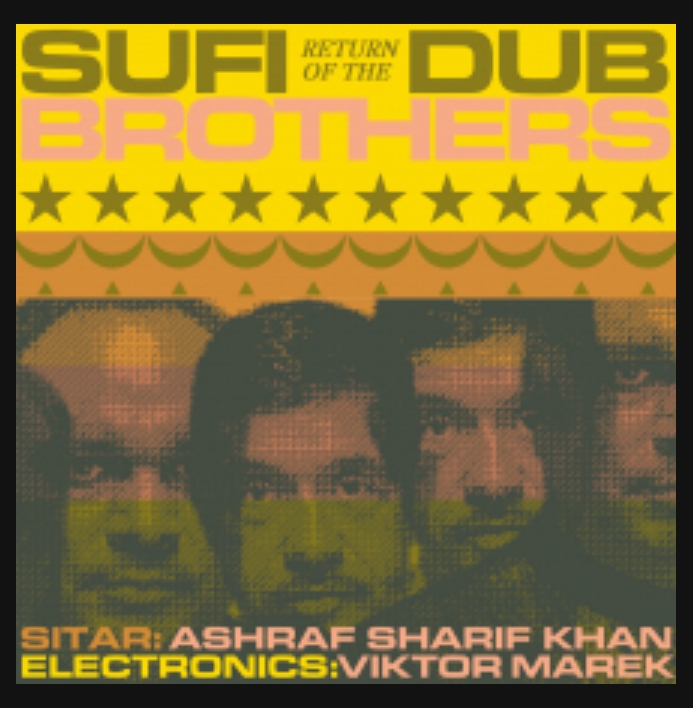
In the 15th year of their collaboration and five years after their debut album, they are back—and finally even officially under the name that festival bookers had long since given them: Sufi Dub Brothers. While their debut album still bore their real names and carried “Sufi Dub Brothers” in the title only, they have now become just that: The Sufi Dub Brothers. So it seems fair to say that their new album, “The Return Of The Sufi Dub Brothers” , is more than a comeback: it’s a manifesto in more than one sense.
What Marek and Khan do is neither world music nor club tool, neither classical exoticism nor dub retrospective—and that’s exactly why it works. Sitar ragas collide with bass-soaked echo chambers, acid loops flicker over hip-hop grooves, while the music repeatedly spirals into trance-like heights. At times it sounds like cosmic raga meditation, at times like bassline excess from the future, and most of the time like both at once.It’s truly amazing to hear the symbiotic relationship that has developed between Marek’s beat ideas and Khan’s sitar playing. There’s a unique magic in how every tiny percussive element immediately flows into Khan’s playing, and conversely, how every microtonal string bend immediately tempts Marek into new electronic experiments.
And, of course, the album reaches far beyond Hamburg and Lahore: in “Doumba”, for example, Patrick Kabré from Burkina Faso appears as a singer, activist, friend—and makes it clear that this music is not simply fusion, but a practice of real encounter. It is these encounters that give the pieces a breadth that extends beyond Hamburg, Lahore, and Ouagadougou.
However, the first single taken from “The Return Of The Sufi Dub Brothers” is the track “Barsaat”. The impressive video by Timo Schierhorn and Markus Eberhardt shows the two on their journey through one of Hamburg’s most absurd allotment garden colonies until they finally arrive at the roof of Ebbe Road Studios in Hamburg Groß-Borstel. This is also where they recorded their album. It’s amazing what the sound of the sitar does with the images from the drone.
“The Return Of The Sufi Dub Brothers” is not just a dance record update, but rather a soundtrack to a space movie that no one has made yet. Music from the inner space of two exceptional musicians who make their tracks sound like quantum leaps between inner and outer worlds. Virtuoso, psychedelic, high-energetic. Welcome back—to a reality that may no longer be ours.
 VENTS MAGAZINE