
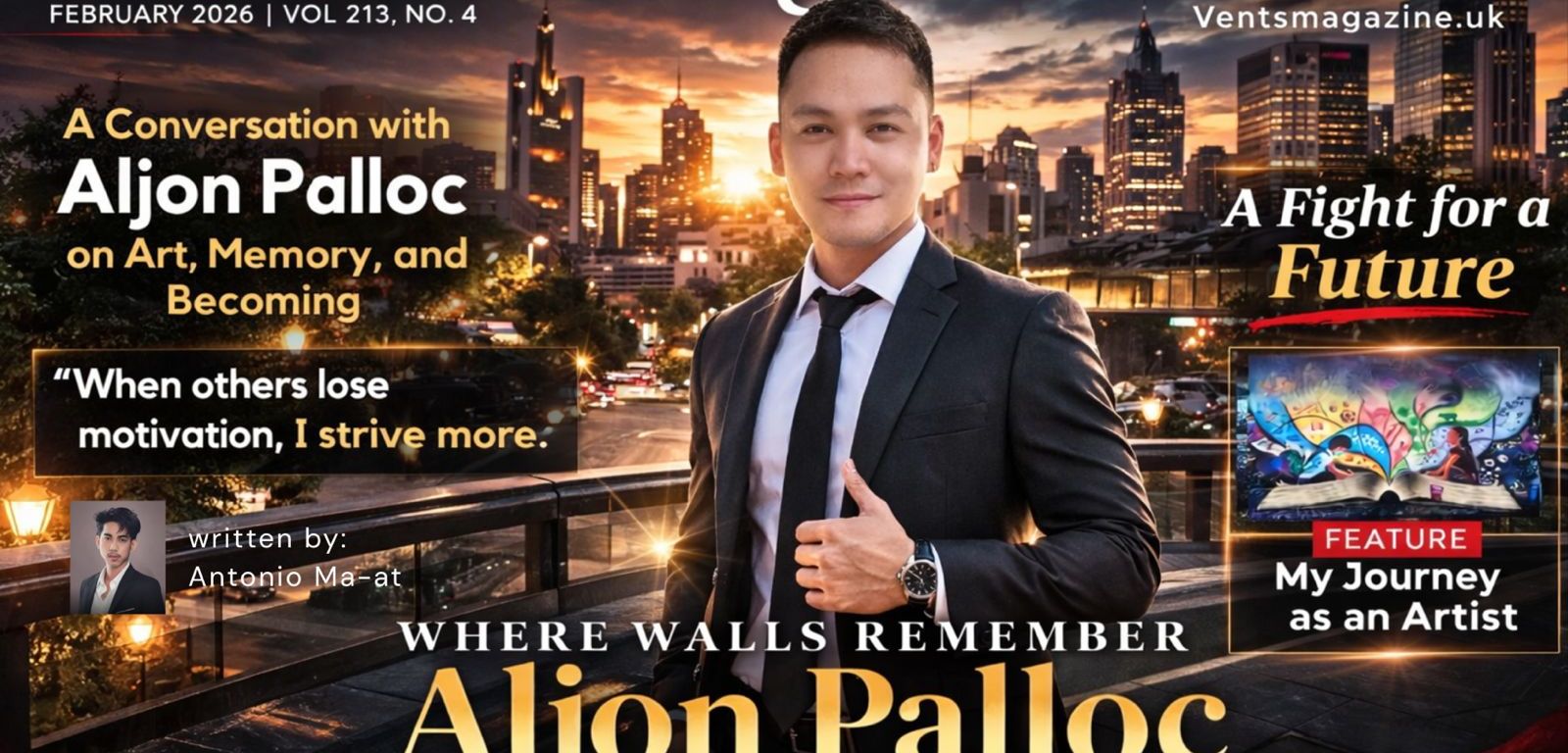
Some artists paint to decorate.
Others paint to remember.
For Aljon Palloc, walls are not blank surfaces. They are witnesses.
“They remember everything,” he says softly. “Not just the painting—but what the artist was going through while painting it.”
It is an idea that echoes throughout his body of work. His murals do not scream for attention. They breathe. They hold silence. They preserve emotion in a state of suspension—somewhere between breaking and becoming whole. It is no coincidence that Aljon calls his signature approach “Preserve.” A visual language rooted in frozen memory, stillness, and survival.
Before recognition, before competitions, before walls stretched across cities, there was a boy in Catarman, Northern Samar, quietly drawing on the cover of his notebook.
Q: When did art stop being just something you enjoyed and become something you needed?
Aljon: I was eight years old when my father noticed I had drawn the cover of my notebook. He was surprised. From that moment, I started copying comics from newspapers, especially faces. I didn’t know what “style” was back then. I just wanted to understand how drawings worked.
In high school, I told myself that I would improve if I did everything on my own. When there were group projects, I preferred to handle them alone. I wanted to experience every mistake, every correction. I believed that growth happens when you take full responsibility for your work.
Reflection:
Some journeys begin with grand dreams. Others begin with quiet discipline.
Aljon’s early relationship with art was never about fame. It was about curiosity. About patience. About a young mind slowly teaching itself how to see.
After high school, life took him in another direction. He joined a networking business and, for a time, stepped away from art. But the distance only clarified what he had been suppressing.
Aljon: I couldn’t ignore it anymore. I started accepting commissions again. I even got a tattoo as a pact with myself—to really begin again and take art seriously. It was my personal promise that I would not abandon this path anymore.
That promise would soon be tested.
When Aljon began working as an artist in Samar, recognition came—but so did resistance.
Q: What was it like establishing yourself in your local art scene?
Aljon: It was painful. I experienced a lot of crab mentality. Some people were angry because I was becoming a multi-awarded painter. I was outcasted in group chats. They discouraged me and told me I would never improve, that my talent was only good for elementary level.
What hurt most was that some of these words came from people who were leaders in our local art community.
Instead of confronting them, Aljon chose distance.
Aljon: I didn’t fight. I didn’t explain. I just left.
Reflection:
Sometimes the bravest act is not proving others wrong, but choosing to keep going.
With little more than faith and determination, Aljon moved to Manila.
Q: What were your first months in Manila like?
Aljon: I had no place to stay. I slept on basketball courts. Sometimes near client locations. I used cardboard as my bed and my slippers as a pillow. I kept praying every day. After weeks, I finally found a place to stay.
Those memories remain vivid.
Aljon: The suffering became my inspiration. Whenever I feel tired now, I remember those days.
Reflection:
Pain, when carried long enough, becomes fuel.
Everything shifted when Aljon earned his first steady income from art.
Q: When did you realize art could truly be your career?
Aljon: When I got my first commission and was paid. I realized—pwede pala kumita dito. I worked consistently for two years. When I saw that my income from art could be higher than what my regular job could give, I decided to pursue art full-time.
My family believed in me. They told me there is nothing wrong with a decision if you stand by it.
The pandemic, unexpectedly, became another turning point.
Q: How did that period affect your journey?
Aljon: For me, it was a blessing in disguise. Artists were in demand. I had many clients, competitions, and projects. While other industries were struggling, I was able to grow. I quit my networking job and fully committed to art.
Pressure did not break him. It refined him.
Aljon: When people doubt me, I work harder. When others lose motivation, I strive more. I see every hardship as a stepping stone.
Commissions during this time were relentless. Clients dictated styles. Deadlines were tight. Creative control was limited.
Aljon: One client wanted doodle art. Another wanted realism. Another wanted something surreal. It was exhausting, but it taught me flexibility.
When I returned to Manila after a period with no projects, that’s when I finally discovered my own style.
Q: You call your style “Preserve.” What does that mean?
Aljon: It represents frozen emotion. Frozen memory. The time when I felt broke, stagnant, and scared. That feeling became my art. I want to preserve those emotions so they are never forgotten.
Reflection:
Some artists paint beauty. Others paint truth. The rare ones paint both.
Aljon’s first mural happened through competition.
Aljon: A teacher invited me to join. The wall was eight feet wide. We had three days. I was used to canvas, not walls. But I tried. I became champion.
That victory ignited something.
He would later win fast-painting competitions with only twenty minutes to conceptualize and execute a piece.
Aljon: I pretend I’m alone so I don’t get nervous. I just focus.
One of his most demanding projects involved painting three large walls in Tagaytay in a single day under a fairytale theme.
Aljon: I was under extreme pressure. I prayed a lot. I even used a blower to dry the paint faster.
Humility anchors every success.
Aljon: I always remind myself—pride is a downfall. I stay grateful but humble.
When informed that he was named AAA Distinguished Mural Artist of the Year, his first instinct was disbelief.
Aljon: I thought it was a scam because I didn’t apply. But when I researched and saw everything was real, I felt overwhelmed.
Behind his persistence stands the quiet influence of his father.
Aljon: My father pushed me to become an artist. He told me not to chase a fixed salary, but to focus on what I love. Before he passed away, he told me, “Ikaw na ang bahala sa mga kapatid mo.” That stayed with me.
Today, Aljon is a full-time mural artist whose dream extends beyond borders.
Aljon: I want to paint murals in Europe. Art is deeply appreciated there.
Q: What advice do you give young artists?
Aljon: Continue your dream. Dream big and aim higher. Ignore negativity. Focus on your goal. Surround yourself with people who lift you up. Be consistent.
Final Reflection:
Great art does not ask to be understood.
It asks to be felt.
Aljon Palloc did not become an artist because life was easy.
He became an artist because he refused to disappear.
And wherever his murals rise—
Walls remember
 VENTS MAGAZINE